
Weapon detection on the cameras your school already owns.
How GroundsWatcher looks for guns on the IP cameras a school already has, how it handles look-alikes, and what we've measured so far.
Guide. Updated November 18, 2026.
What "existing cameras" means here
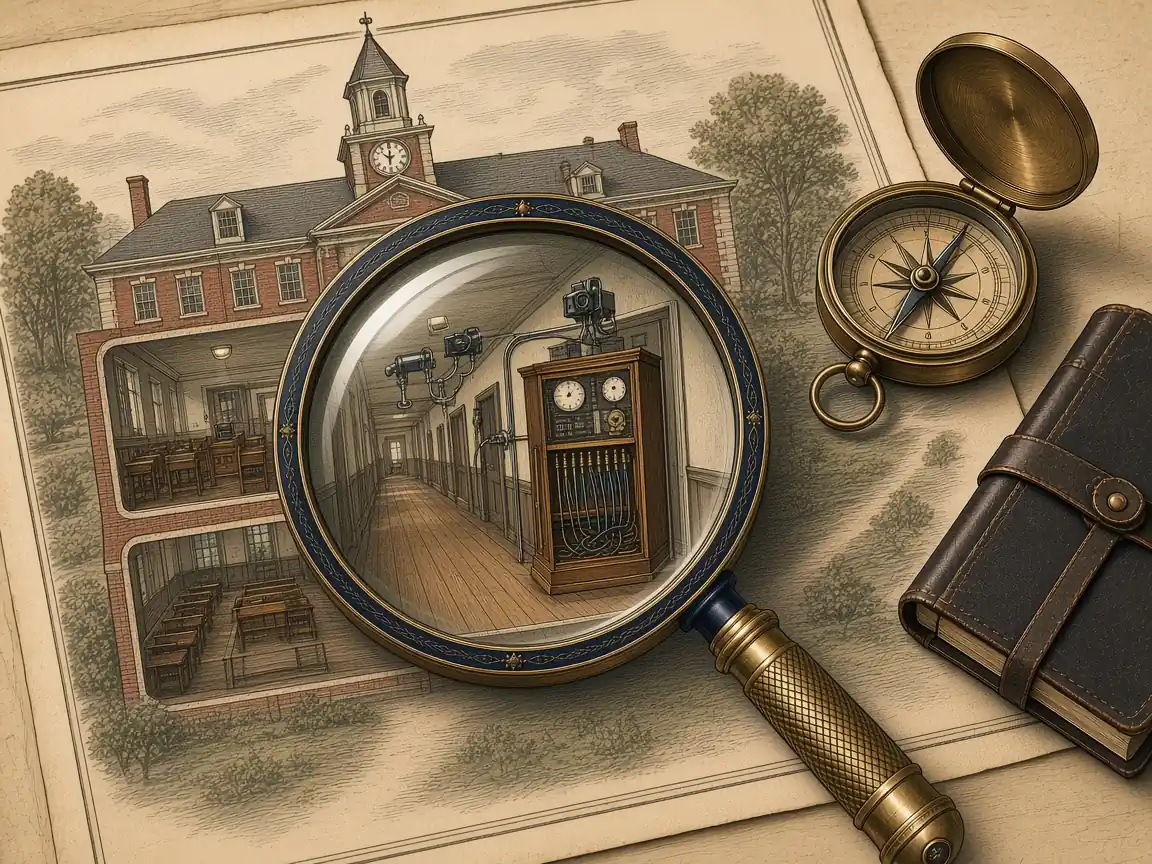
GroundsWatcher reads the standard video streams your IP cameras already send. Most IP cameras connect over RTSP, and GroundsWatcher finds ONVIF cameras on its own. Nothing new goes on the walls, and your recorder keeps recording wherever it lives today, on a recorder on site or in a cloud service.
The work runs on the GroundsWatcher box, sized to your cameras at setup. We check your gear during the gap map. If a camera can't give a usable picture, we tell you which one and why.
How a handgun alert gets made
- Find every person. The person detector and tracker follow each person in view, one track per visit.
- Look at the hands. GroundsWatcher cuts the hand area from the full-resolution frame, so a small handgun down a hallway isn't shrunk away.
- Hold for a few looks. The gun has to show up more than once before anyone is paged, so one odd frame doesn't send an alert.
- Re-check the full frame. Eyes, our automatic re-check, looks at the full frame before anyone is paged and puts its verdict on the alert.
Long guns get the same steps, checked on the upper body as well as the hands. A rifle is bigger than a handgun, so it can be caught on people farther from the camera, on outdoor walkways and lots as well as hallways. See visible handgun and long gun.
Look-alikes and the automatic re-check
Phones in a two-hand grip, umbrellas, instrument cases and toy guns are the things that trip gun detectors. Eyes looks at the moment again at full detail and writes a verdict: consistent with a weapon, unclear, or likely look-alike, with one plain sentence of why.
A likely look-alike drops to low priority. It stays on the list, so staff can see every candidate. Eyes can lower an alert's priority. It can't delete one. More on how Eyes works. No outside reviewers watch your cameras.
What staff get
The staff you name get the still with the gun boxed, the camera and the place, a short clip from just before the first frame, and the Eyes verdict. GroundsWatcher never calls a lockdown or locks a door by itself. A person makes the call. It never reads faces.
What we've measured
These are lab tests on licensed public datasets and school-camera research video. Each one names its test set and date on the results page.
- Eyes review, HBD21 held-out set, Nov 17, 2026. 12 of 12 gun raises kept. 0 of 14 false yeses on no-gun people.
- Fresh school-camera video, Nov 18, 2026. 0 false raises from the gun-look screening step in 3.956 camera-hours, on 48 MEVA clips never used in tuning. This run counts false alarms only. It doesn't measure how many guns get caught.
- Phones and objects in hand, Nov 16, 2026. 0 of 2,290 crops judged a gun at bar 0.7, and 2 of 2,290 at bar 0.5.
Some numbers are weaker, and we publish those too. On the HBD21 held-out set, the scan on its own, before Eyes, caught 12 of 24 gun clips with 0 alarms on 14 no-gun clips. On 140 other HBD clips, Eyes kept 39 of 45 gun raises, below our own pass line of 42 of 45.
Related pages

See it on your own cameras.
We bring the box, set it up on the cameras and doors you have, and walk your staff through it.
The careful eye on every campus.